
We explain how to calculate your horse’s total daily feed ration. This calculation is the total amount of food that your horse needs per day. It includes hay or haylage, grass and any hard feed you need to feed.
What does your horse currently weigh?
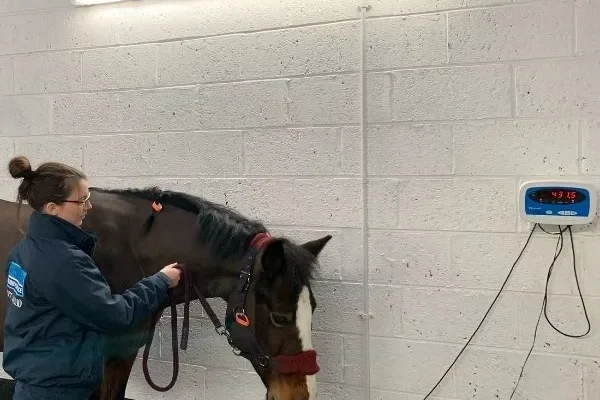
How much feed your horse needs will depend on several factors. The first thing to know is how much they currently weigh. If you don’t have access to a set of weigh scales then a weight tape will give you a fairly accurate figure.
How much work is your horse currently doing?
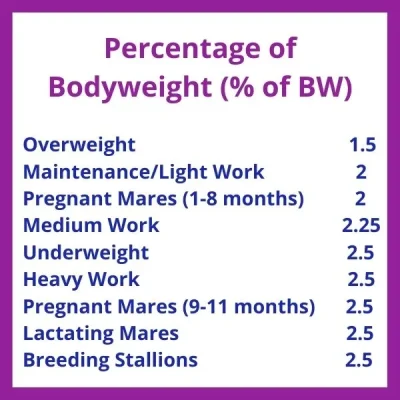
Once you know how much they weigh you need to decide on the percentage of bodyweight to feed based on how much work your horse is in and whether they are overweight, healthy or underweight.
Horses in light work are those horses who are doing light hacking and schooling for up to and average of one hour per day, four-five times a week. If you do some local and unaffiliated competitions, then this is still only light work for most horses.
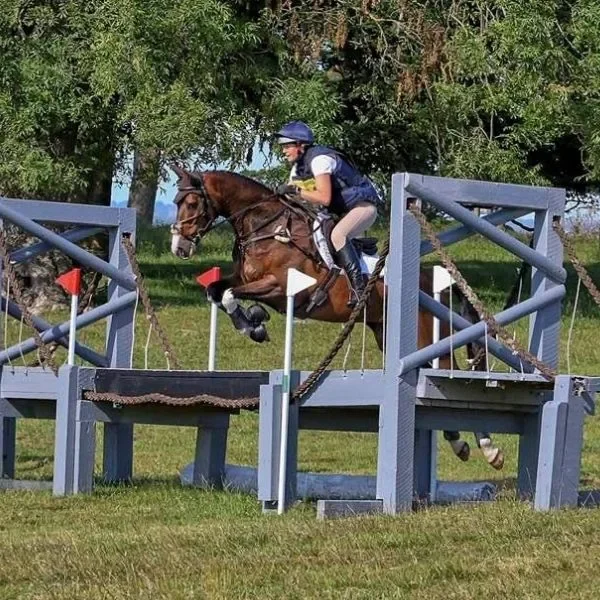
Horses in medium work are doing more intensive regular schooling/jumping sessions for around one hour a day and may also be doing affiliated competitions.
Horses competing at the higher affiliated levels are in hard work as their training and fitness schedules reflect the extra work required to keep them at the top of the game.
If your horse is overweight then you probably need to reduce the level of feeding so a horse that is overweight and in light work should be fed for maintenance and/or as overweight.
Horses who are overweight but in medium work should be moved down a level and fed as those in light work. If they are really overweight then you may need to reduce this even further.
When it comes to assessing your horses weight the most important thing to remember is to be honest with yourself. Most horse owners massively underestimate just how fat their horse is.
In recent weeks there have been posts on social media about obesity and laminitis. It is important to remember that laminitis is not the only health risk posed to horses who are overweight.
- Strangulating lipomas: Fatty growths that can wrap around the gut, which can cause life-threatening colic.
- Hyperlipaemia: Dangerous levels of fat in the blood, often fatal.
- Abnormal appetite: Changes in eating habits.
- Whole body inflammation: Can lead to joint, heart, and lung problems.
- Arthritis and joint disease: Worsened by excess weight.
- Exercise intolerance: Reduced stamina or reluctance to work.
- Possible organ disease: Higher risk for liver, kidney, and other organs.
You can read our download on how to body condition score your horse correctly here or watch how to condition score with Baileys Horse Feeds.
Body condition scoring is useful when done alongside using a weigh tape. Whilst a weigh tape may not give you a completely accurate reading, by using it and recording weight weekly/bi-weekly, you will be able to tell if your horse has lost, or gained any weight.
Understanding the difference between Dry Matter and Fresh Weight
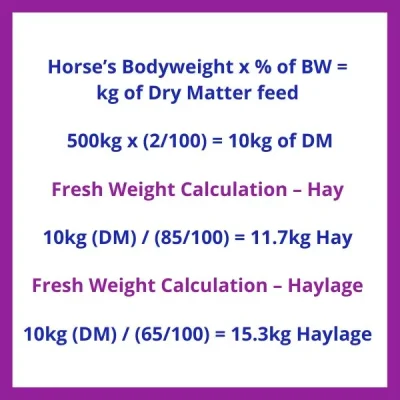
Just because your hay feels dry doesn’t mean it is 100% dry matter. It actually contains approximately 15% water so is only 85% dry matter. Haylage is baled before it has dried out so is around 60-70% dry matter.
When you are calculating your horse’s ration it is important to work out the daily dry matter first and then calculate how much hay or haylage to actually feed (fresh weight).
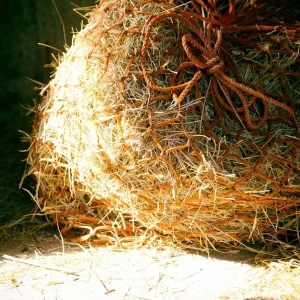
- New hay is ready to feed almost straight away IF it is dry enough (dry matter of over 88%)
- Hay is traditionally left for a few weeks to ‘cure,’ especially in the UK, because unreliable weather often results in hay with a higher than ideal moisture content. This excess moisture can promote microbial activity after baling, making it unsafe to feed immediately. Allowing the hay to cure ensures that most of this activity has ceased, reducing the risk of digestive issues or mold exposure for animals.
- Moisture probes can be used to test the moisture in bales, but if in doubt leave hay for 4 – 6 weeks after harvest.
- In an emergency you can open bales, spread the contents undercover to dry so you can feed it.
- When haylage is made, when it is wrapped, the grass is still damp meaning the grass begins a fermentation process. It is important that haylage is never fed while this is still going on. Six weeks from baling is a good guide.
Daily Dry Matter Calculation
For this example we have 500kg horse who is in light work and not overweight and therefore needs 2% of their bodyweight per day.
How do you know how much grass they are eating?
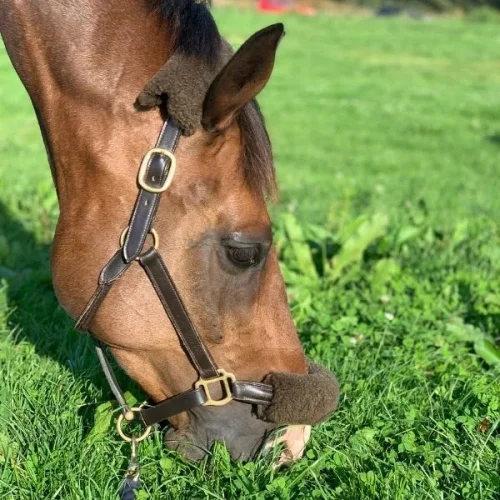
If your horse is out on grass this needs to be factored into the total forage calculation. For starters fresh green spring grass contains approximately 20% dry matter and 80% water.
According to the Kentucky Equine Research centre horses out at grass will eat about 0.45 -0.9kg of dry matter grass. If your horse is out 24 hours a day, you can expect them to graze for about 16 hours of that so they may eat up to 7 – 15kg of grass per day. This is the equivalent to 1.6 – 3.2% of their bodyweight per day.
Feeding the overweight horse
For the overweight horse never drop below 1% of body weight. If you are feeding 1.5% of body weight and your horse is still not loosing weight you need to reduce the energy content of your forage rather than reduce the quantity of feed per day. You can do this by:
- Soaking hay for up to 12 hours to reduce the nutrients and calories in the hay
- Sourcing low energy hay. Most feed companies can arrange for your forage to be analysed but you can also send samples to SRUC
As a rough guide:
Low energy hay – 8MJ/kg
Medium energy hay – 8-9MJ/kg
High energy hay – over 9MJ/kg
- Mixing clean oat or barley straw in with hay. You can safely feed up to 1/3 of the total hay ration as straw.
Hard Feed
If your horse requires more energy and you want to add in hard feed to their diet you will need to reduce the amount of hay or haylage that your horse is getting. Choosing the right hard feed for your horse can be really confusing as there are so many options on the market.
Speak to a reputable feed company or independent nutritionist for advice and keep an eye out for our next blog in our feeding series where we try to demystify some of the facts (and myths) around hard feed.
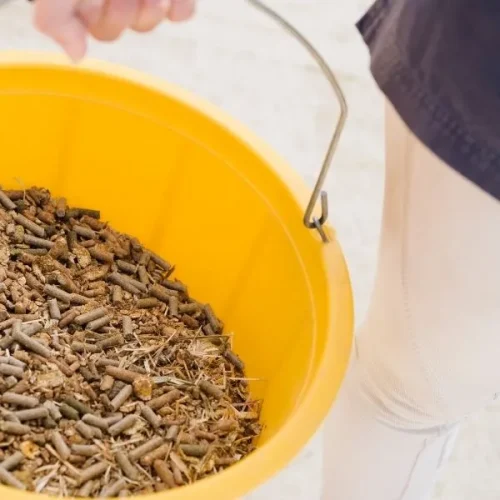
Remember that all horses, even those dieting, will still need an adequate vitamin and mineral intake which can be found from high quality approved supplements, or by feeding a balancer.
Weigh your forage
Finally weigh your forage. There is no point doing this calculation if you don’t then weigh how much you are feeding. No one haynet will weigh the same and you might be surprised at how much this can vary. Always think weight not volume!
All horse’s should be treated as individuals and most feed companies have regional reps available via their own helplines, who will be delighted to advise you on what is right for your horse.
Photo Credit: Action Replay Photography