
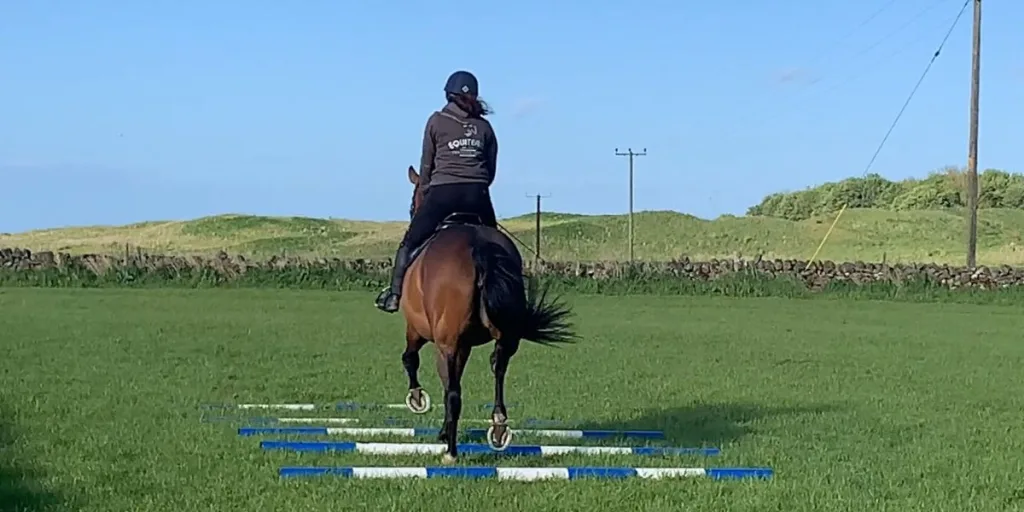
Last week I was fortunate enough to sit and listen to Grand Prix dressage rider and UKCC Level 4 coach, Tom Graham teach a wide variety of lessons at Equiteam’s Dressage Camps.
I am like a sponge and I always enjoy watching other coaches give a masterclass. It also gives you more time to think, ‘what would I do, ‘what would I say’, ‘what exercises would I use to help this?’
I noted a few times, Tom explaining to various different people that they were going to go back to basics in the lesson, using transitions in different ways as a clever tool. I heard him say to lots of his clients ‘I’m sorry if this is boring, but we are just going to do this a few times because…’
The power of repetition
In my own teaching, and in my own training, I use the tool of repetition a lot. I am a huge believer that a horse has a brain and should be allowed to understand the questions and allowed to make mistakes. Our job as a rider, and a coach, is to communicate in a way they understand so that they know what we are asking.
I find it really frustrating when people are trying something new, or fixing an existing issue, that after a couple of attempts if their horse gets it wrong or ‘doesn’t do as they ask’, that they dismiss it, get frustrated with their horse and believe that their horse can’t do it, or is no good at something.
Were you good at every single thing you tried for the first time? I know I wasn’t! But I do know that I needed someone patient to help me learn.
Pole work is a really good example of this – I often find myself saying ‘Your job as a rider is to maintain the rhythm and straightness, the horse has four legs and a brain – let them use it and figure it out.’
But we wouldn’t just do one set of poles for one day and expect the horse to know what they are doing. We would introduce them as part of their training so that they can build confidence, skill and technique alongside understanding.
And that is where, as riders we can often fall down – we don’t always want to spend the time ironing out the creases on the bits that the horse finds tricky.
Is it the expectation of wanting to do well all of the time, feeling pressured to progress maybe – or the feeling that you’re not achieving a goal that you have set?
And with running the risk of being unpopular – when you sigh, huff and puff, your shoulders go down and your poor horse is trying his best despite not really ‘getting’ it yet; from where your coach is standing it can look a bit like a temper tantrum and disappointment in your horse.
Instead of rewarding him for trying and acknowledging that he is probably doing exactly what you are asking – you are inadvertently scolding him for not being able to do something or being a mind reader. He will be sensing this too…
Believe in the process
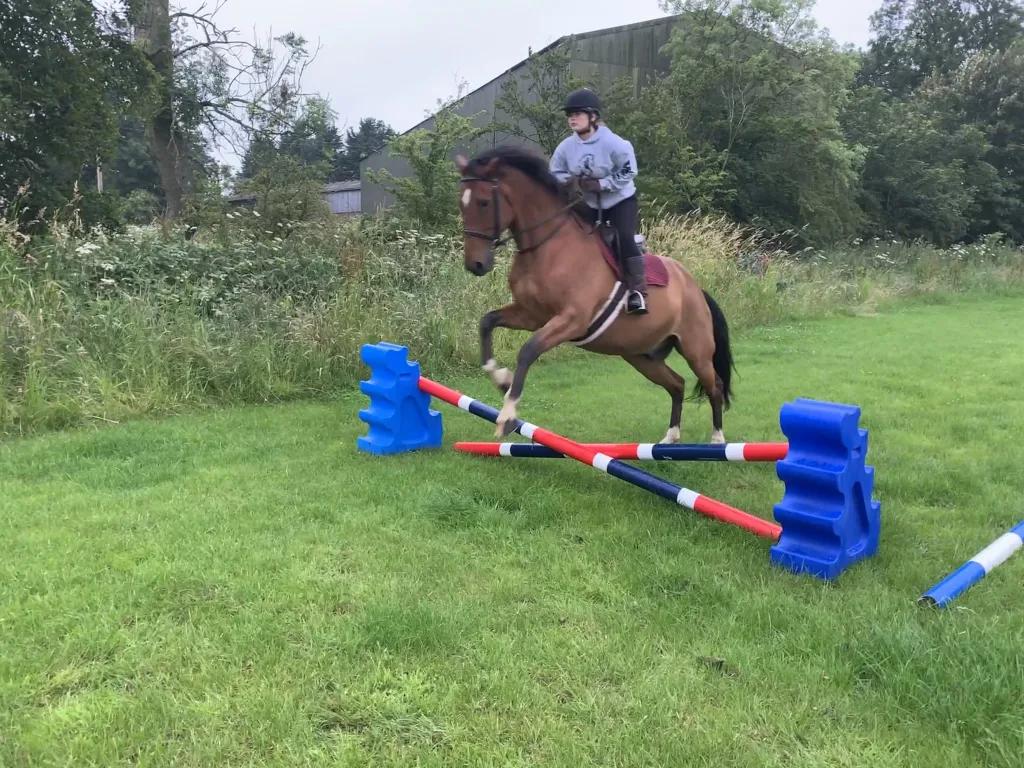
We recorded a video for EquiTeam the other day looking at an exercise that can help your horse from rushing after a fence. We warmed up with lots of transitions to ensure that the horse understood the basic question of a transition and that the rider was asking correctly. Once we were happy we progressed to poles on the floor and continued with the transitions which went smoothly.
Then we put a small cross pole up – the same repetitive exercise only this time there was a jump instead of poles. The first few times it didn’t go to plan – nothing drastic – just not to plan as the horse reverted back to rushing at the cross pole.
As a coach I know that it’s perfectly OK and normal. I trusted the process and I trusted the repetition.
I asked the rider to keep coming, to keep repeating the transition after the fence in the exercise and after maybe five or six times the horse started to wait for the aid to slow down after the fence.
It would have been easy by the third or fourth time to have a huff but instead of getting frustrated the rider kept asking the question until the horse understood.
The power of positive repetition
The power of positive repetition is also one of the most useful tools when it comes to building rider (and horse) confidence. Whether it is hacking, jumping, schooling, competing, tackling a ‘bogey’ fence – positive repetition is so valuable.
How many times did you pick up a pen before you could write correctly? And how many hours did you practice writing for to develop your skills?
Now equate that to how much time you have actually spent doing transitions after fences, jumping a variety of skinny or arrow head fences, practising over fillers etc etc.
Maybe some positive repetition might be the key ingredient in the progress you so desperately want?
Liz x