

We all know how essential leg protection is for horses in certain circumstances – but there is very little evidence-based testing behind some of the major brands.
Because we like facts and figures, we asked Equilibrium to share some of the testing and the results that they have done, in order to get a deeper understanding of what we should be looking for when selecting boots for our horses.
There are of course lots of other brands available – but here is what they have to say.
Equilibrium believe your horse deserves the same level of safety consideration as you do with your hats and body protectors for example — and that means rigorous, evidence-based testing.
The Equilibrium Tri-Zone Boots undergo a unique three-phase testing process designed to ensure your horse receives the very best in lightweight, breathable, and protective legwear.
Here’s how they test — and why it matters.
Why Horse Boots Should Be Treated as Safety Equipment
As riders, we don’t hesitate to wear helmets and body protectors — both of which undergo rigorous testing to meet safety standards. Shouldn’t the same standard apply to the protective equipment our horses wear?
Injuries to a horse’s lower limbs are not only common but can be serious and long-lasting. Despite this, most horse boots on the market aren’t tested under controlled conditions. That’s why we developed a multi-layered testing process for our Tri-Zone Boots, with the same lab that certifies riding hats and body protectors.
Phase 1: Independent Laboratory Testing
Protection: Concussion and Penetration
To assess impact protection, a custom-built test rig is used with a vertical drop tower. A blunt hammer and a cutting blade are dropped on separate occasions from varying heights onto the boots in a controlled environment.
- The weight of the hammer and blade is fixed.
- The height is varied to produce forces ranging from 1.25 to 20 Joules, which are equivalent to real-world scenarios such as overreaching or striking a fence.
- This simulates the kind of impact forces horses might encounter during exercise or sport.
The aim is to ensure boots can absorb and deflect both blunt trauma and sharp strikes — without compromising on comfort or weight.
Poor shock absorbtion
High shock absorbtion
Heat & Breathability: Why It Really Matters
Boots that trap heat can have serious consequences for your horse’s leg health. Research has shown that 80% of tendon cells die when exposed to 48°C for just 10 minutes (Taylor et al., 2002). That’s why breathability isn’t just a comfort feature — it’s a critical health factor. Excess sweat that can’t evaporate can also cause skin issues on horses’ legs.
The boots are tested in two ways:
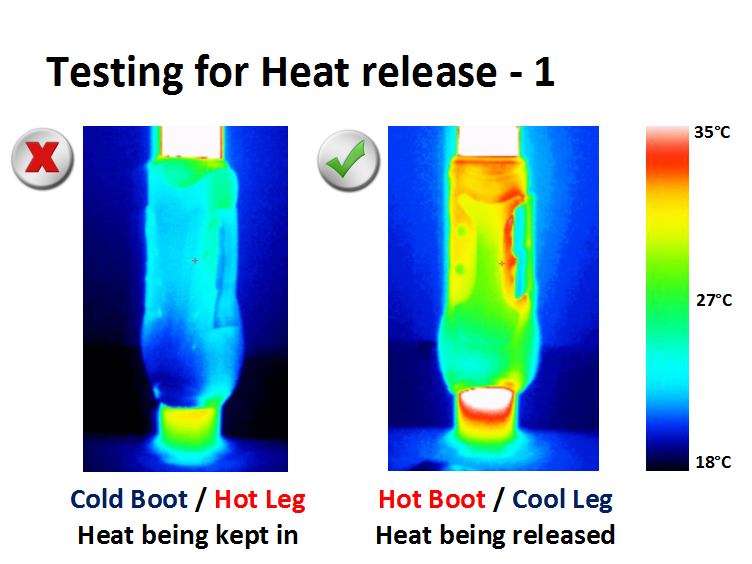
1. Thermal Surface Imaging
Boots are placed over a metal flask filled with water heated to 45°C in a 20°C room.
- A thermal camera measures surface temperatures.
- Cooler boots trap heat inside — a bad sign.
- Warmer surface readings show the boot is releasing heat effectively.
2. Active Heat Release Measurement
To simulate air movement during exercise, 20°C air is blown over the boot using a fan.
- The rate at which the internal water cools tells us how quickly the boot can release heat.
- This method allows us to compare our Tri-Zone boots directly with other boots on the market.
In recent tests, Tri-Zone Brushing Boots allowed 87% more moisture to escape — significantly reducing the risk of heat-related tendon damage. Read more on this here.
Flexibility: No Movement? Big Problem
Boots that are too stiff or tight can restrict joint movement, affecting stride length, balance, and even causing issues like tendonitis. Our testing ensures freedom of movement without compromising on protection.
- A boot is attached to a 1m-long, 8cm steel pipe fixed to a workbench.
- A 10kg weight is clipped to the boot to simulate flexion.
- We measure the degree of bend under pressure — boots must flex naturally around the horse’s leg without resistance.
Flexible materials also improve fit, prevent rubbing, and reduce the likelihood of gait disruption.
Weight: Light, Even When Wet
Even small increases in weight at the end of the limb significantly affect a horse’s energy use and stride. Some boots can double in weight when wet — which impacts stamina, performance, and joint health.
Our boots are tested for:
- Dry weight – to ensure minimal effort during movement.
- Water absorption – by simulating wet conditions (rain, puddles, or water jumps).
Tri-Zone boots are designed to stay light in all conditions — crucial for competition, eventing, and long-distance rides.
Phase 2: Rider Testing Panel
The boots are then handed over to a wide panel of amateur and semi-professional riders to wear during everyday riding and turnout. They test the boots on real horses and provide detailed feedback on:
- Fit and ease of use
- Comfort and skin sensitivity
- Washability and durability
- Practical performance in varied conditions
Phase 3: Professional Rider Trials
The final hurdle: rigorous testing with our professional rider team. These boots are used daily by Olympic competitors, eventers, and top producers who push them to the limit in high-impact disciplines like show jumping and cross-country, but also accelerate testing on the boots durability when they’re being used day in and day out on multiple horses.
Choosing the Right Boot for Your Horse
Tri-Zone Brushing Boot – For light work, turnout, and hacking. The most breathable option. Use on front or hind legs.
Tri-Zone All Sports Boot – All-round protection with internal tendon strike guard. Great for hacking, jumping, schooling, and riding through water. Use on front or hind legs.
Tri-Zone Impact Sports Boot – Maximum protection for high-impact sports or accident-prone horses. Specifical hind boots provide extra coverage.
Tri-Zone Tendon Boot & Fetlock Boot – Popular for show jumping. Open front tendon boots for airflow and compliance with governing body standards.
Horse boots aren’t just accessories — they’re protective equipment. If you’re investing in your horse’s safety, make sure their boots have the science to back it up.
With Tri-Zone, you get boots independently tested, scientifically validated, and trusted by professionals.
Thank you Equilibrium for sharing your findings with us. EquiTeam members: don’t forget you can find your exclusive Equilibrium discount code on your My EquiTeam page.
References
Taylor, P. M., et al. (2002). The effect of exercise-induced localised hyperthermia on tendon cell survival. Journal of Experimental Biology.