Horse riding demands strength, balance, and subtle control – but one area that often gets overlooked is the pelvic floor. Whether you’re returning to the saddle after childbirth, managing symptoms like leaking or heaviness, tackling the challenges that menopause brings, returning to the sport after a hysterectomy, or simply wanting to ride with more stability and confidence, pelvic floor rehab can make a real difference.
This isn’t just about doing a few squeezes and hoping for the best. Effective rehab blends awareness, lifestyle habits, and functional strength that translates directly into your riding.
Why the pelvic floor matters in riding
Your pelvic floor works in coordination with your deep core, hips, and breathing to stabilize your seat. A well-functioning pelvic floor helps you:
- Maintain a balanced, independent seat
- Absorb movement through your hips instead of gripping
- Reduce lower back and hip tension
- Prevent symptoms like leaking or pelvic heaviness
When it’s not functioning well—whether too weak, too tight, or poorly coordinated—you may notice stiffness, bouncing in the saddle, or difficulty maintaining position.
Rethink “Strength”
Pelvic floor rehab isn’t just about strengthening – your pelvic floor needs to meet the demands placed on it, it’s all about control, coordination, and responsiveness.
Some riders actually have overactive pelvic floors (constantly gripping), which can be just as problematic as weakness. An assessment with a pelvic health physio can diagnose this.
Everyday lifestyle changes that help
Small daily habits can either support or strain your pelvic floor:
- Don’t “hover” over the toilet – Fully relax when you go – hovering can train your pelvic floor to stay tense.
- Manage intra-abdominal pressure – Avoid holding your breath when lifting hay bales, mounting, or doing yard work. Exhale gently on effort. Work on exercises that expand your ribcage and release the abdominals to allow the pressure to have somewhere else to go! Think Child’s pose and cat/cow.
- Address constipation – Straining puts repeated stress on the pelvic floor. Hydration, fibre, and relaxed toilet posture matter more than you might think. Raise your feet up off the floor onto a footstool and lean forward when moving bowels.
Foundational pelvic floor exercises
Before progressing to riding-specific work, build a base:
1. Connection Breathing
- · Sit or lie comfortably
- · Inhale: let your ribs expand, not just at the front, but sides and back too, and allow the pelvic floor to soften
- · Exhale: gently lift the pelvic floor.
This teaches coordination – not just clenching.
2. Gentle Kegels (done properly)
- Lift and hold for 3–5 seconds
- Fully relax for the same time
- Repeat 8–10 times
- Do this 3 times per day
Focus on quality, not maximum effort. No gripping your glutes or thighs.
3. Quick Contractions
- Lift quickly, then fully relax
- Repeat 10 times
These help with responsiveness, useful for moments like sitting a sudden transition
Functional strength for riders
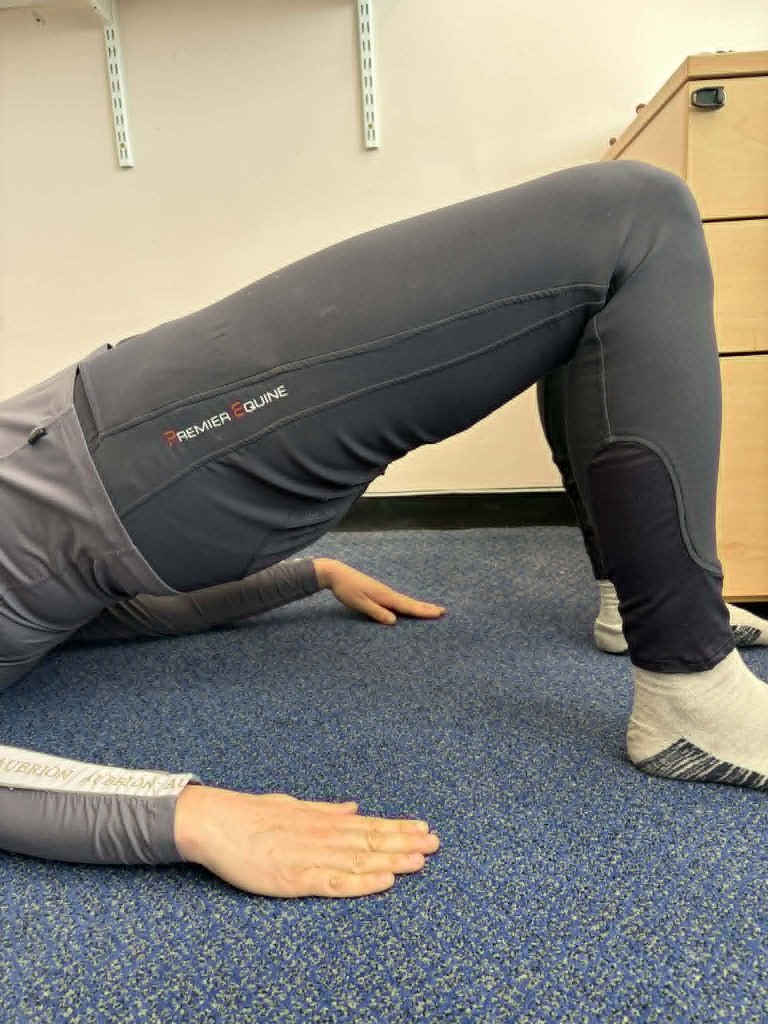
Glute Bridges
- Lift hips while gently engaging pelvic floor and a posterior pelvic tilt
- Helps connect glutes and core – key for a stable seat
- Progress to single leg bridges when able to do this with stability and no dipping of the pelvis on one side
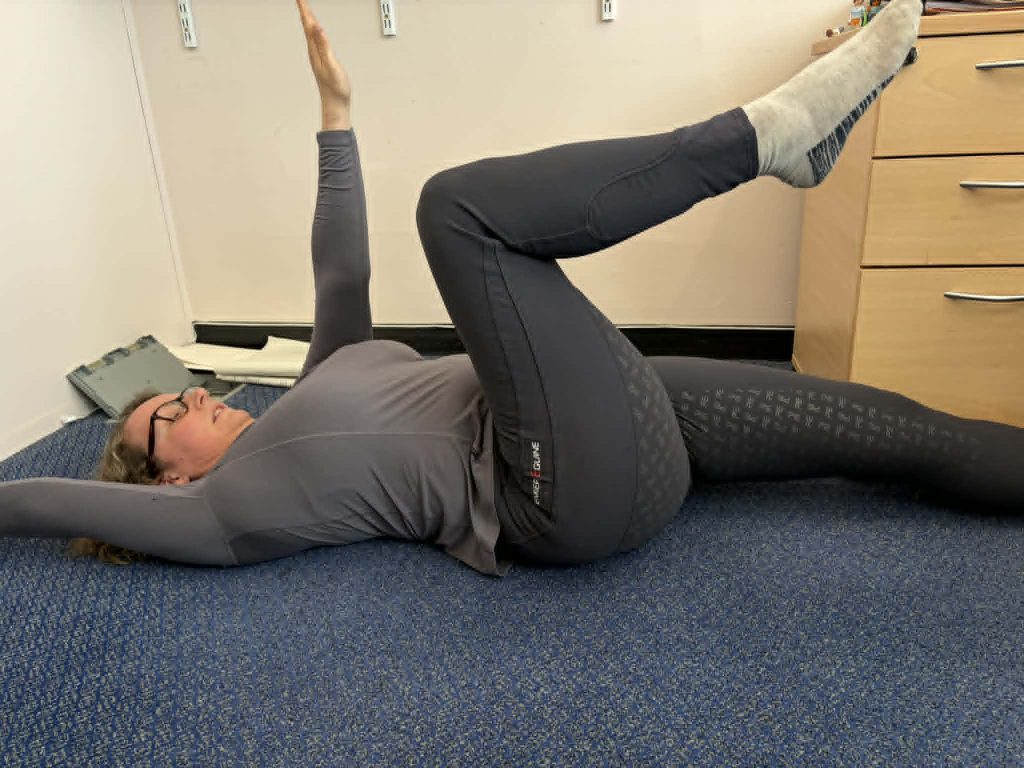
Dead Bugs
- Lying on back, maintain a neutral spine while moving arms/legs away from the body.
- You can add weights to arms or resistance bands to legs to progress this
- Teaches control under movement (just like riding)
Kick stance hip hinges
- Stand on one leg with the other behind, resting on the wall
- Hold a 5kg kettlebell in the opposite hand to the front leg
- Hinge your hips back towards the wall while folding at the hip of the stance leg lowering the kettlebell towards the outside of your foot
- Stand back up
This is fantastic for strengthening the glutes and hip rotators which help to stabilise the pelvis and restore balance.
In-the-saddle awareness
Pelvic floor rehab becomes truly effective when it transfers into your riding:
- Check for gripping: Are you clenching through transitions?
- Breathe with movement: Avoid holding your breath during sitting trot or canter
- Allow movement: Your pelvic floor should respond, not brace constantly
Think of your seat as adaptive, not rigid
When to get extra support
If you’re dealing with symptoms like:
- Urinary leakage
- Bowel leakage
- Pelvic pain
- Heaviness or dragging sensations
- Pain during riding
…it’s worth seeing a pelvic health physiotherapist. Rehab is highly individual, and guidance can speed things up significantly.
Final thoughts
Pelvic floor rehab isn’t about becoming tighter or more rigid – it’s about becoming more responsive, balanced, and connected. For equestrians, that translates directly into a more effective, comfortable, and confident ride.
If you approach it consistently and integrate it into your daily habits, you’ll likely notice improvements not just in symptoms, but in your overall riding performance too.
Good social media to follow
Life Fit Wellness: https://www.lifefitwellness.co.uk/
Activate Your Seat: https://www.facebook.com/activateyourseat
Dr Becky Allan: https://www.thepelvicpowerhouse.com/
Mamastefit: https://www.instagram.com/mamastefit/
Carolinepackarddpt: https://www.instagram.com/carolinepackarddpt/
Spring.physio: https://www.instagram.com/spring.physio/
Dr.lisa.dpt: https://www.instagram.com/dr.lisa.dpt/
Thank you to EquiTeam member Kate Leishman, Advanced Practice Pelvic Physio for this brilliant information